DeepScheduling is progressing toward the definition of a Common Modeling Language for Hybrid Temporal Scheduling (CML4HTS), a key step in enabling interoperable, solver-agnostic scheduling solutions for complex industrial environments.
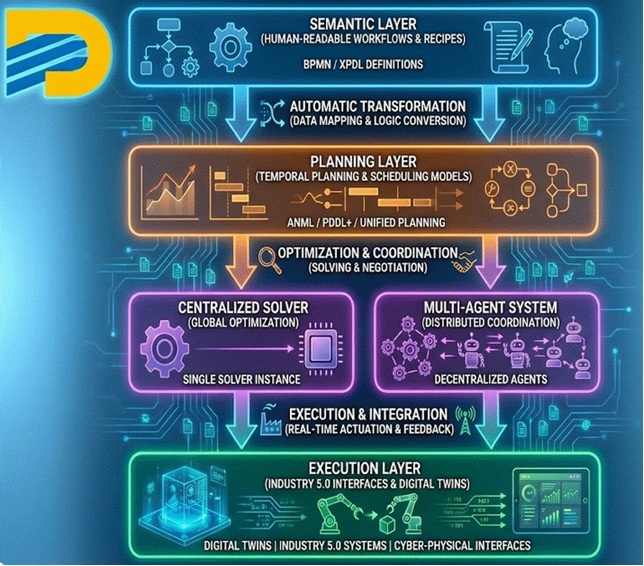
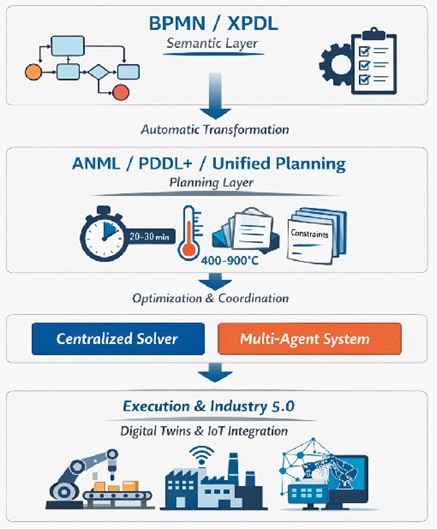
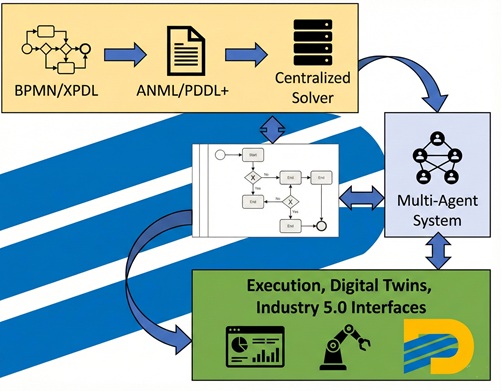
The proposed approach introduces a layered modeling framework that separates business-level process semantics from machine-solvable scheduling representations. High-level workflows and recipes are expressed using BPMN/XPDL, while temporal planning and scheduling models are automatically compiled into ANML, PDDL+, or Unified Planning representations.
This architecture supports:
• Explicit modeling of temporal, numeric, and resource constraints
• Translation into multiple optimization paradigms, including centralized planners and multi-agent approaches
• Integration with Industry 4.0 standards, semantic technologies (RDF/SPARQL), and digital twin concepts
• Extensibility toward real-time data sources such as IoT sensors and execution systems
The work establishes a formal pathway from human-readable industrial process descriptions to executable scheduling models, enabling reproducibility, explainability, and systematic comparison of AI-based scheduling techniques.
This initial proposal serves as a foundation for the upcoming requirements definition (Task T3.1) and opens the discussion with the research and industrial communities.