
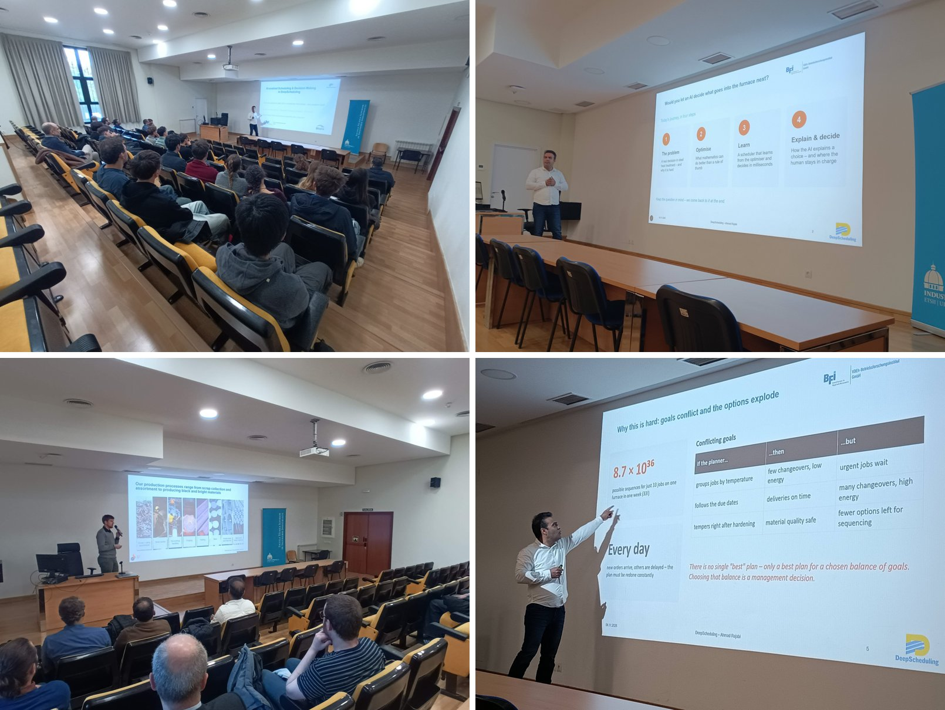
During the DeepScheduling consortium meeting at Universidad Politécnica de Madrid, Master’s students from the Escuela Técnica Superior de Ingenieros Industriales (ETSII) joined project partners to explore a fundamental question: Who should make the final decisions in an AI-supported heat treatment plant?
On 4 November 2026, as part of the DeepScheduling consortium meeting hosted by Universidad Politécnica de Madrid (UPM), Master’s students from ETSII participated in the seminar „Explainable AI and Human-Centric Scheduling for Sustainable Manufacturing.“
The seminar brought together industrial practitioners, researchers and future industrial managers to discuss how artificial intelligence can support complex production scheduling decisions while keeping human expertise and responsibility at the centre.
The event followed the project’s earlier announcement: If AI Agents Can Plan Production Autonomously, What Is the Planner For?
From Industrial Reality to AI-Supported Scheduling
Lars Hartmann, responsible for heat treatment at Deutsche Edelstahlwerke (DEW), part of Swiss Steel Group, introduced the industrial environment in Witten where DeepScheduling is being developed and validated.
He explained the complexity of heat treatment operations: each production order requires a specific combination of temperatures and processing times, while individual furnaces have different technical capabilities and operating constraints.
Production planners must therefore consider not only delivery requirements and equipment availability, but also the energy and time required for furnace temperature changes. Looking several days ahead helps reduce unnecessary temperature adjustments and maintain efficient operations.
Unexpected disruptions make these decisions even more challenging. When a furnace breaks down or production conditions change, planners must rapidly decide whether to adjust furnace temperatures, maintain current operating conditions or wait for suitable material.
These are precisely the situations in which AI-supported scheduling can provide valuable assistance.
Is There Really an Optimal Production Schedule?
Ahmad Rajabi (BFI) then challenged the audience with the central question of the seminar:
Would you let an AI decide what goes into the furnace next?
Using practical examples from industrial heat treatment, he illustrated the competing objectives that make production scheduling particularly challenging.
Grouping orders according to their required treatment temperatures can reduce furnace temperature changes and energy consumption. However, this approach may delay urgent customer orders.
Conversely, prioritising orders strictly according to their delivery deadlines may improve delivery performance but result in more frequent temperature adjustments and higher energy consumption.
The central message was clear:
There is no single best production schedule. There is only a best schedule for a chosen balance of objectives.
Determining this balance is not simply a mathematical optimisation problem. It also involves business priorities, operational experience and management decisions.
Learning-based AI scheduling methods can explore alternative production sequences and react rapidly to changing conditions. However, their recommendations are not necessarily self-explanatory.
DeepScheduling therefore investigates how advanced AI methods can be combined with operational rules, explainability and the expertise of human planners to support transparent and reliable scheduling decisions.
Students Challenge the Decision-Making Process
The discussion with the Master’s students highlighted several practical questions about the implementation of AI in industrial production.
How does the system handle particularly important customers?
The scheduling model can incorporate customer priorities through weighting factors. For certain high-priority orders, delivery requirements may take precedence over energy-related optimisation objectives.
Does the AI learn from historical production data?
Historical data can provide valuable information for developing learning-based scheduling approaches. However, their relevance depends on how closely past operating conditions reflect current production. Changes in recipes, product portfolios and market requirements mean that older data may become less representative over time.
Who ultimately makes the decision: the AI or the human?
This question emerged directly from the student feedback. One participant summarised the challenge succinctly:
„Who chooses, the AI or the human?“
Another student highlighted the example of forcing a particular production order to the beginning of a schedule as especially illustrative of the challenges planners face when priorities suddenly change.
These contributions demonstrated that the challenge is not only to develop powerful scheduling algorithms, but also to determine how their recommendations should be interpreted, evaluated and applied in real industrial environments.
Towards Human–AI Collaboration in Industrial Scheduling
The approach being pursued by DeepScheduling is based on a clear principle:
The AI proposes and explains. The human planner evaluates and decides.
AI systems can analyse numerous scheduling alternatives, identify potential conflicts and support rapid responses to disruptions. Human planners contribute operational experience, contextual knowledge and an understanding of organisational priorities that cannot always be fully captured in mathematical models.
Effective human–AI collaboration requires more than simply allowing a planner to approve an automatically generated schedule. It also involves transparency, trust, feedback and a clearly defined allocation of responsibilities.
Determining which decisions can be automated, when human intervention is necessary and how the boundaries of AI autonomy should be established remains an important aspect of designing practical industrial AI systems.
Connecting Research, Industry and Education
The Madrid seminar provided an opportunity to connect the industrial challenges addressed by DeepScheduling with the perspectives of future engineers and managers.
The exchange reinforced the importance of developing AI-supported scheduling solutions that are not only technically effective and energy-efficient, but also understandable, trustworthy and compatible with real industrial decision-making.
DeepScheduling would like to thank the participating students for their thoughtful questions and active engagement, as well as Universidad Politécnica de Madrid for hosting the consortium meeting and seminar.
Further Information
- DeepScheduling – Original Seminar Announcement
- UPM – Explainable AI and Human-Centric Scheduling for Sustainable Manufacturing
About DeepScheduling
DeepScheduling develops AI-supported approaches for more efficient, adaptive and sustainable production scheduling in the European steel industry. By combining advanced scheduling methods, industrial knowledge and human-centred decision support, the project aims to improve production efficiency and contribute to more sustainable manufacturing.
Funding Acknowledgement
DeepScheduling has received funding from the European Union’s Research Fund for Coal and Steel (RFCS) under grant agreement No. 101216553.
The views and opinions expressed are those of the authors only and do not necessarily reflect those of the European Union or the European Commission. Neither the European Union nor the granting authority can be held responsible for them.
[Insert EU flag and RFCS lo
go]