
1. Executive Summary
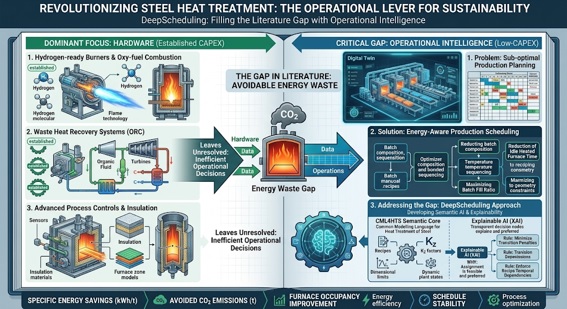
Heat treatment of steel is an essential, energy-intensive metallurgical phase designed to grant critical mechanical and structural properties to high-performance steel products. While significant academic and industrial attention has historically been devoted to hardware-level decarbonisation (such as hydrogen combustion or waste heat recovery), the operational layer, specifically production scheduling, remains an under-exploited lever for energy reduction. This article reviews the current state of the art, formulates the unique characteristics of the steel heat treatment scheduling problem, and outlines the critical gaps that the DeepScheduling project addresses.
2. Industrial Context: The Dual Challenge of Metallurgy and Sustainability
In steel manufacturing, heat treatment involves controlled cycles of heating, soaking, and cooling executed in batch or continuous furnaces. Temperature profiles, soaking durations, cooling media, and intermediate delays directly determine grain refinement, phase transformations, and ultimate mechanical performance. Once a thermal cycle commences, the metallurgical route is largely rigid and irreversible.
From a sustainability perspective, heat treatment furnaces represent major points of thermal energy consumption and industrial emissions. Achieving decarbonisation in this sector requires addressing both technological hardware efficiency and operational execution.
3. Review of Existing Literature & Technological Pathways
3.1 Furnace-Level and Hardware Innovations
The literature on industrial furnace efficiency has traditionally focused on physical and chemical engineering interventions:
- Combustion & Burner Technology: Optimization of air-fuel ratios, oxy-fuel burner integration, and transitioning to hydrogen-ready combustion systems.
- Waste Heat Recovery: Implementation of Organic Rankine Cycles (ORC) and heat exchangers to capture energy from flue gases and wall losses.
- Process Modeling: Computational Fluid Dynamics (CFD) and zone-based thermal modeling to enhance heat transfer and internal temperature uniformity.
3.2 Production Planning and Operational Scheduling
In parallel, scheduling literature in operations research has extensively studied Job-Shop and Flexible Flow-Shop problems. However, generic scheduling models often fail when applied to steel heat treatment due to domain-specific complexities:
- Batch Processing Constraints: Orders must be grouped into batches subject to physical furnace capacities, volumetric limits, and metallurgical compatibility.
- Thermal Inertia & Transition Penalties: Switching a furnace between different operating temperatures requires non-trivial heating or cooling phases, consuming fuel/electricity without performing productive work.
- Sequence-Dependent Setups: Processing sequence directly dictates furnace ramp-up and cool-down cycles.
- Dynamic Plant Disruptions: Real-world operations suffer from order priority changes, furnace downtime, cooling line bottlenecks, and process deviations.
4. Identified Gaps in Current Literature
Despite advancements in both hardware engineering and operations research, a critical synthesis gap remains:
- The Operational Gap: High-efficiency furnaces are frequently operated sub-optimally due to manual or spreadsheet-based scheduling. This introduces avoidable energy losses through idle heated time, low batch fill ratios, and sub-optimal temperature sequencing.
- The Semantic & Trust Gap: Advanced AI and mathematical optimization algorithms are frequently developed as „black-box“ models. They lack explicit semantic integration of complex metallurgical recipes ($K_z$ factors, cooling routes) and fail to provide explainable feedback to human planners, resulting in low industrial adoption.
5. Conclusion & Research Horizon
Hardware upgrades are essential but require high capital expenditure (High-CAPEX) and long implementation timelines. Optimising the operational schedule represents a immediate, Low-CAPEX decarbonisation pathway. The DeepScheduling project addresses this horizon by developing an energy-aware, semantically-grounded decision support framework for steel heat treatment operations.