DeepScheduling Framework: Semantic Modelling, Explainable AI, and Low-CAPEX Decarbonisation via SEEP 2026
1. Executive Summary
At the SEEP 2026 Conference (Tor Vergata University, Rome), the DeepScheduling consortium presented its core methodological contribution: „Energy-Aware Production Scheduling as a Low-CAPEX Decarbonisation Lever for Steel Heat Treatment“ (J. Comino, M. Grijalvo, J. Ordieres-Meré). This article details the structural framework of the DeepScheduling approach, introducing the CML4HTS semantic modelling language, the operational energy mechanisms, and the explainable assessment architecture.
2. The Low-CAPEX Decarbonisation Paradigm
Furnace efficiency at the component level does not guarantee energy efficiency at the plant level. If production planning generates unsynchronized scheduling gaps or poor batching, furnace energy is wasted maintaining high temperatures during unproductive periods.
The DeepScheduling framework formalises operational planning as a direct decarbonisation lever that complements hardware investments. By refining operational decisions, steelmakers can achieve immediate reductions in specific energy consumption (kWh/t) and CO2 emissions without altering existing furnace machinery.
3. Operational Energy Mechanisms in Heat Treatment
The methodology identifies five core mechanisms through which scheduling decisions directly impact energy performance and sustainability:
| Mechanism | Scheduling Root Cause | Energy & Sustainability Impact | DeepScheduling Operational Lever |
| Idle Heated Time | Gaps between consecutive compatible loads, poor resource synchronization. | Fuel/power consumed to maintain temperature without thermal processing. | Synchronises upstream/downstream resources and compresses inter-batch gaps. |
| Temperature Transitions | Frequent switching between orders requiring different process setpoints. | High thermal inertia leads to heavy energy expenditure during ramp-up/cool-down. | Groups production into compatible thermal classes and optimizes temperature sequences. |
| Furnace Occupancy | Sub-optimal batch formation or assigning small lots to large furnaces. | Lower mass of steel processed per thermal energy cycle. | Maximises volumetric and mass fill ratios subject to recipe constraints. |
| Recipe Adherence | Delays between constrained process stages or cooling bottleneck waiting times. | Deviations impair metallurgical quality and require energy-intensive re-treatments. | Enforces strict temporal dependencies and coordinates auxiliary cooling assets. |
| Reactive Inefficiency | Manual, slow rescheduling in response to dynamic plant disruptions. | Emergency re-routing causes emergency holds and uncoordinated furnace heating. | Enables rapid, automated rescheduling while preserving schedule stability. |
4. Core Architecture: The CML4HTS Semantic Layer
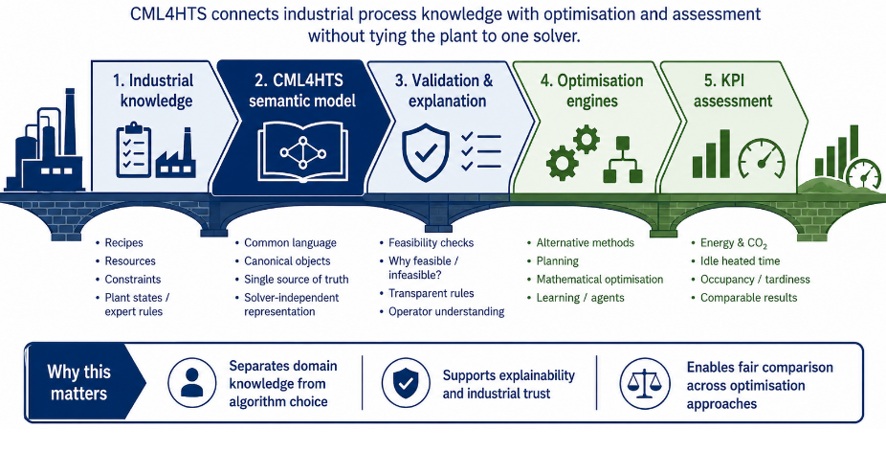
A primary innovation of the framework is CML4HTS (Common Modelling Language for Heat Treatment of Steel), an open, solver-independent semantic interoperability layer.
Key Capabilities of CML4HTS:
- Solver Independence: Decouples industrial plant knowledge from specific optimisation algorithms (whether MILP, Constraint Programming, Reinforcement Learning, or Metaheuristics).
- Explicit Metallurgical Validation: Pre-validates feasibility regarding Kz factors, dimensional envelope bounds, and mandatory cooling medium availability before triggering optimisation.
- Single Source of Truth: Converts heterogeneous plant data (spreadsheets, ERP outputs, operator rules) into unified, machine-readable canonical objects.
5. Human-in-the-Loop & Explainable AI (XAI)
Industrial trust is paramount in high-value steel manufacturing. DeepScheduling embeds explainability directly into the decision pipeline across three distinct layers:
- Semantic Explanations: Clarify why specific batch combinations or resource assignments are feasible or infeasible based on metallurgical rules.
- Optimization Explanations: Provide mathematical transparency regarding why a specific schedule was selected over alternative feasible candidates.
- What-If Explanations: Allow planners to simulate alternative scenarios (e.g., overriding order priorities or modifying furnace availability) and evaluate immediate KPI impacts.
6. Assessment Framework & Expected Impact
The framework establishes a standardized multi-level assessment logic comparing historical manual baselines against optimized schedules. The key performance indicators (KPIs) evaluated include:
- Thermal Efficiency: Percentage reduction in Idle Heated Time and increase in Productive Heated Ratio.
- Environmental Impact: Direct reduction in estimated CO2 emissions per processed tonne.
- Operational Performance: On-Time Delivery (OTD), tardiness reduction, and overall furnace occupancy rate.
By unifying domain semantics, advanced AI solvers, and human supervision, DeepScheduling delivers a practical, scalable, and Low-CAPEX solution for sustainable industrial manufacturing