
On February 28, 2026, U.S. and Israeli airstrikes on Iran triggered an unprecedented disruption in global energy supplies and prices, according to the International Energy Agency. On March 2, Iran declared the Strait of Hormuz closed, the maritime passage through which 20% of the world’s liquefied natural gas and 25% of its maritime oil trade typically passes. Whereas 20 million barrels of petroleum products were previously transported daily, this amount dropped dramatically to just over 3 million barrels following the outbreak of the conflict. Although a ceasefire was announced in early April, ship traffic through the Strait of Hormuz remains well below pre-war levels.
For the European steel industry, the impact was immediate and direct. Natural gas prices in Europe nearly doubled, exceeding €60/MWh, at a time when European gas storage facilities were below 30% of capacity following the winter. Manufacturers in energy-intensive sectors, including the steel industry, have implemented surcharges of up to 30% to offset the cost of electricity and raw materials.
However, the price of gas is not the only problem that a crisis of this kind poses for a steel heat treatment plant. There is a second, more critical effect: the disruption of production planning.
Complex manufacturing sectors are particularly vulnerable when delivery times become unstable. If incoming materials are delayed or transportation costs rise significantly, production planning becomes increasingly complex and lean production models come under pressure. In long-product steel heat treatment plants, this translates to: urgent orders being canceled without notice, new priority orders, fluctuations in gas availability, or unstable furnace sequences. Today, the ability to react to a disruption has become one of the key indicators of industrial resilience.
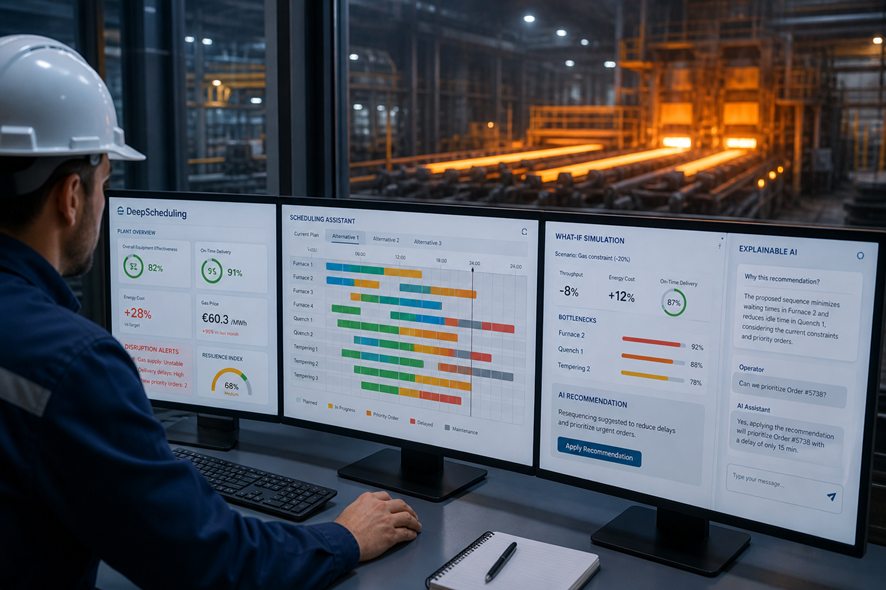
In this scenario, DeepScheduling demonstrates a capability that goes beyond energy efficiency: operational resilience in the face of external disruptions. The project’s technical proposal explicitly identifies among its main motivations the need to adapt heat treatment planning to changing environments and potential disruptions, as well as the need to replan in the face of urgent orders or unforeseen breakdowns. To address this, the system incorporates a reactive planning strategy based on multi-agent systems capable of reallocating resources and orders in real time in response to unscheduled events.
The system, composed of explainable AI, evaluates every available resource in the plant and automatically readjusts to any changes, without requiring the operator to manually redo the planning from scratch. However, the operator is not excluded; they can adjust, question, or modify the system’s decisions at any time thanks to an interface specifically designed to facilitate human-machine collaboration.
Companies that have adopted digital supply chain analysis tools can perform what-if simulations and prioritize their responses in complex situations. DeepScheduling brings this approach into the plant. The ability to simulate alternative sequencing scenarios is one of the features of the planning assistant being developed by the project.
Geopolitical disruption is not a one-off phenomenon that disappears with the cessation of hostilities. It is a source of permanent uncertainty for industrial planning.
In this context, what makes the difference is no longer just the price of resources, but the speed with which a plant is able to reorganize its production in the face of unexpected changes.