
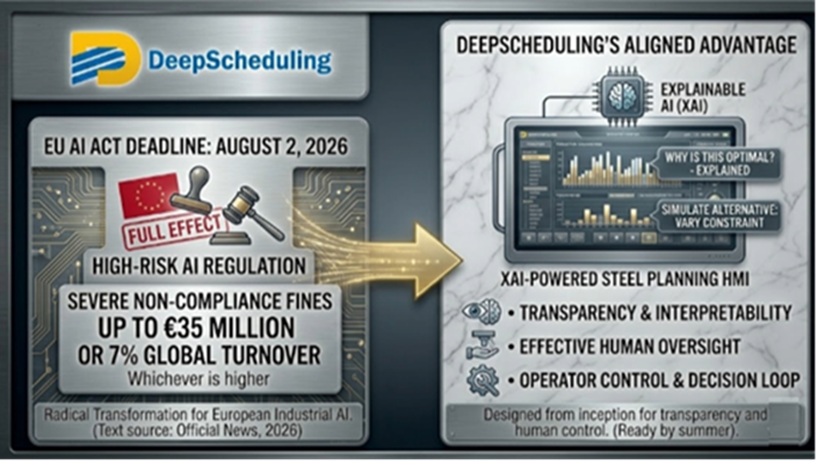
On August 2, 2026, the European Union’s Artificial Intelligence Regulation, the world’s first comprehensive AI legislation, will come into full effect. While many European industrial companies are under pressure to adapt their AI systems to the new regulatory requirements, our project will reach that date with a significant advantage: its design principles align perfectly with what the law requires.
The EU AI Act, adopted in August 2024, which has been gradually phasing in its obligations, will reach full implementation in just four months. From that date onward, AI systems operating in high-risk environments within the European Union must comply with a series of technical requirements that represent a radical transformation from the previously unregulated environment. Fines for non-compliance can reach 35 million euros or 7% of the company’s global annual turnover, whichever is higher.
Some of the provisions require that AI systems be sufficiently transparent so that users can interpret their results and use them appropriately, as well as allow for effective human oversight throughout their operation.
In the industrial context of steel production planning, these requirements describe a system that: explains why it has generated a specific production sequence, allows the operator to verify the logic behind each decision, offers simulations of alternatives to evaluate different scenarios, and can be adjusted at any time by the operator in charge. This is exactly what DeepScheduling has developed since its inception, through its explainable AI (XAI), its human-machine interface (HMI), and its integration of human oversight into the decision loop.
While other European industrial companies face the challenge of modifying systems that were designed as black boxes, DeepScheduling started from the opposite principle: transparency and operator control. The system not only optimizes heat treatment but also shows the planner why that production order is optimal, what variables it has considered, what alternatives it has evaluated, and what would happen if any constraint were modified.
DeepScheduling is not just an energy-saving tool for the steel industry; it is an example of how to design explainable industrial AI, with transparency and human control from the outset, just as European regulations will require of the entire industry starting this summer.