
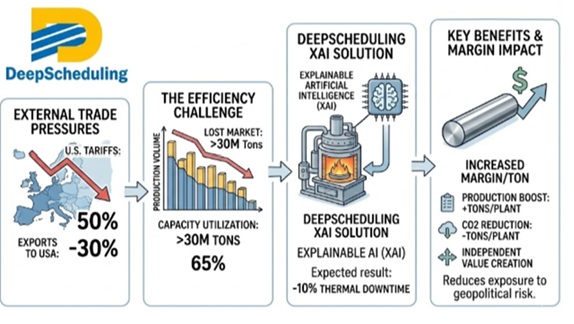
Amid unprecedented trade pressure, with U.S. tariffs of 50% on European steel and exports to the American market plummeting by 30% in just a few months, our project, DeepScheduling, shows that one of the few variables the European steel industry can control is its internal efficiency.
This past April, the Trump’s administration confirmed that it would maintain the 50% tariffs on imported steel and aluminium; although it includes a revision to the calculation, this does not alleviate the pressure on European products. According to EUROFER, the European Steel Association, the steel industry in Europe has lost more than 30 million tons of market volume since 2018, due to a combination of excess capacity in Asia and repeated U.S. trade measures. European production capacity utilization has fallen to 65%, a level that the European Commission itself describes as unsustainable in its Action Plan for Steel and Metals from March 2025.
In this scenario, the duty-free import quotas established by the EU were exceeded in just two days after they took effect. EUROFER convened an Emergency Steel Summit and called on the European Parliament and the Council to urgently adopt the new trade measure proposed by the European Commission, which would impose a 50% tariff on imports exceeding those quotas.
The competitiveness of European steel cannot depend solely on negotiations. Energy costs typically account for a significant percentage of steel production costs, and therefore, reducing operational inefficiency becomes the factor with the greatest direct impact on the margin per ton produced.
This is where DeepScheduling comes in. Using a system based on explainable artificial intelligence (XAI), the project is expected to achieve a 10% reduction in thermal downtime in industrial furnaces. In practical terms, this will mean increasing effective annual steel production by hundred of tons per plant, along with a reduction of dozens of tons of CO2.
In an industry where operating margins are squeezed by external tariff pressures and competition from low-cost Asian producers, every ton produced more efficiently adds value that is not dependent on trade agreements. DeepScheduling cannot negotiate directly with the U.S., but it can optimize every thermal cycle, every production order, and every minute of furnace activity.
The technology does not eliminate geopolitical pressure, but it does reduce the industry’s exposure to these risks.