The steel industry has been optimising its heat treatment furnaces since the 1930s. Ninety years of research into temperature profiles, heat balances, combustion models and linear programming algorithms. And in all this time, no review article has operationally developed a system in which the worker is part of the decision-making loop.
This phenomenon has a name in the literature on artificial intelligence: human-in-the-loop. The idea is simple: the algorithm optimises, but the operator can understand, question, correct and provide feedback on the system’s decision. A review of the literature shows that this principle has not been implemented in the field of heat treatment planning in the steel industry. Current research, rooted in the Industry 4.0 model, has for years pursued complete automation: an algorithm that makes the best decisions without human intervention.
The knowledge possessed by expert planners, the experience accumulated over many years, is not captured in any of the models reviewed. And in many European plants, that knowledge is on the verge of disappearing: planners with decades of experience are retiring, and there is no system in place to preserve their expertise.
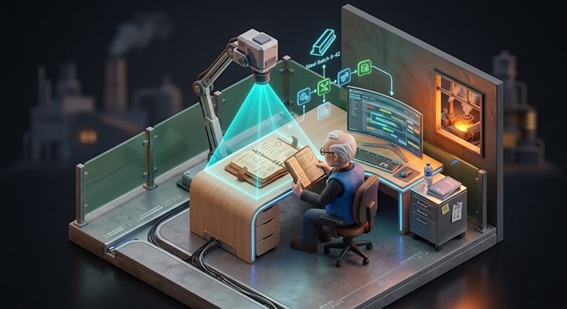
DeepScheduling addresses this gap head-on. The project develops the Human Expertise Integration Method and the Digital Schedule Converter, whose specific function is to digitise the schedules drawn up manually by existing planners so they can be used as training data for the AI system. The result is not just a more efficient algorithm; it is a system that learns from the operator, explains why it proposes each sequence using explainable AI and can be corrected and improved through real-time feedback. The planner is not left out of the system; they remain at its heart.
In a sector where every cubic metre of gas counts, preserving and harnessing the planners’ knowledge can be just as important as developing new algorithms. This is where DeepScheduling’s value proposition lies: combining artificial intelligence and human expertise to optimise production without losing the knowledge accumulated over decades.